
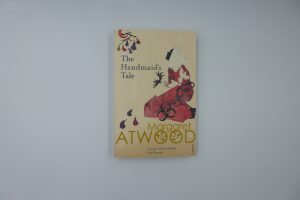
There are several things that you have to understand before beginning to read Margaret Atwood’s The Handmaid’s Tale. The first thing is that everything that Atwood included in her novel she took from human history. Therefore, everything that takes place within the fictional world of Gilead had taken place at some point in history. Second of all, the story is not anti-religious, but it demonstrates how, when taken to the extreme, religion can ruin the lives of people. Thirdly, the character of ‘Offred’ never reveals the name she was called in the time before, allowing the role to be anyone.
Spoiler alert for The Handmaid's Tale- You have been warned
When the novel was first published in 1985, it received mixed reviews. In 2017, it sparked the idea of resistance, particularly with the Hulu adaption starring Elisabeth Moss. However, I am purely talking about the book rather than the TV show, so there will be no spoilers for the television adaption. However, if you have not read the book, I suggest you read that before coming here.
I studied The Handmaid’s Tale as part of my English course. As such, I will review it from when I first read the novel rather than when I was studying it in depth.
Spoilers ahead- I did warn you
The plot
The Handmaid’s Tale starts with the characters at the Rachel and Leah Centre, also known as the ‘Red Centre’. At the end of the first chapter, there is a list of names. All but one are attributed to other characters. The only title not taken is ‘June’ which Atwood told her readers that they could use it if they wished.
The scene changes to Offred’s bedroom in Commander Waterford’s household. The reader assumes that her Commander is Waterford rather than Judd, as revealed in the Historical Notes. She goes shopping with her walking partner, Ofglen, and attends Janine’s Birth Day. During this event, Janine gives birth, and the baby is passed off to Warren and his wife. Offred later attends a Salvaging.
During one of her walks, Ofglen reveals that she’s part of Mayday, a secret resistance attempting to bring down Gilead. After the Salvaging, a new Ofglen replaces her as Offred’s shopping partner. Sorry to the Emily fans from the Hulu adaptation- reveals that Ofglen hanged herself before the secret police, known as the Eyes, could get to her.
Meanwhile, Offred and her Commander begin playing Scrabble, which is illegal as women (excluding the Aunts) are not allowed to read or write. He also takes her to Jezebel’s, a brothel club for the Commanders, where she meets her friend from the time before and at the Red Centre- Moira.
During the last ‘Night’ section, the Eyes come for Offred, saying that she revealed state secrets before she enters the black van. After this chapter, the book jumps forward a hundred years later to show that the Republic of Gilead has fallen, replaced by the United States of America once again. At the head of the talk is Professor Pieixoto, who seems to disregard Offred as an unreliable source. The book ends with ‘Are there any questions?’, effectively closing the book and leaving the readers to wonder what happened to Offred.
My thoughts on The Handmaid’s Tale
I enjoyed reading The Handmaid’s Tale the first time as it is intriguing, exciting and tells the reader what life was like at the start of Gilead.
Overall, I rated the novel four out of five as the Historical Notes do not bring Offred’s story justice. It undermines everything that the reader has discovered in the previous chapter. However, this section is essential so that the reader understands that Gilead is overthrown in the future. Margaret Atwood had made reading The Handmaid’s Tale enjoyable and I will reread it.
Now, over thirty years later, Atwood is releasing a sequel to The Handmaid’s Tale entitled ‘The Testaments’. I cannot wait to discover what is in store for the characters.
