
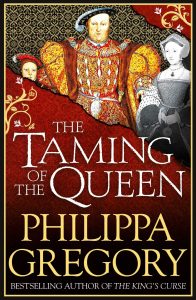
The Taming of the Queen is a historical fiction novel by Philippa Gregory that covers the reign of Catherine Parr from 1543 to 1547. This review contains some of the notes I made when I read the story for the first time.
Spoilers ahead for The Taming of the Queen
In my book reviews, I do reveal spoilers for the plot and characters, so I advise you to go and read the book first if it’s one you’re interested in. After that, you can come back here and share your opinions on the novel.
Of course, I can’t force you to not read this review if you’ve not read the book.
Beware Spoilers ahead- you have been warned.
The plot:
The story begins in 1543 shortly after Catherine Parr has been widowed for the second time. Currently, she is in love with a courtier, Thomas Seymour, but she attracted the unwanted attention of the King. Danger surrounds Catherine throughout the novel through her marriage to the King and her protestant views.
The first danger comes when the King asks her to marry him. Catherine can’t say no, and they are married at Hampton Court. Almost immediately, Catherine’s sister (called Nan in the story), tries to explain to Catherine that she must influence the King through her protestant views. Catherine’s love for Thomas also proves to be a danger since the queen has to act indifferent before the King. The new queen almost gives herself away when she wants to hotly deny that she’ll miss him. This indifference continues throughout the novel up to the King’s death as she doesn’t want to be accused of adultery like Henry’s previous wife was.
Catherine Parr continually compares herself to Henry’s ex-wives, notably Katheryn Howard throughout the novel. Like Katherine of Aragon, Parr became regent when Henry was fighting in France. This portrays how Elizabeth learnt how to rule like a queen since she was with Catherine at the time.
She also wrote a couple of books within her lifetime, one is mentioned in the novel- The Lamentation of a Sinner. At this point, we are shown Catherine’s scholarly side, which puts her in immediate danger. Henry would continuously change his mind upon the Bible and religion based upon those at Court. Catherine’s Protestantism leads to Anne Askew arriving at Court to preach.
In 1545, Chapuys, the Spanish Ambassador, warned Catherine that Henry would not settle for another annulment. He urges her to leave the country if there is any sign of the King growing tired of her. Catherine doesn’t heed his advice, however. Yet when she angers the King about their difference in religion the next year, she takes action when she finds the arrest warrant and can save her life. The next day, guards arrive to arrest the queen, but Henry turns them away, telling Catherine that this is ‘The Taming of the Queen.’
Henry VIII dies at the end of the novel, and Catherine is relieved. Now, she doesn’t have to worry that people will judge her if she’s spotted with Thomas Seymour.
The plot is engaging for historians since most of it is based on fact. The book includes the sinking of the Mary Rose in 1545, Catherine became regent when Henry is in France and Catherine’s love for Thomas Seymour.
What happens after the novel’s end?
At the end of the novel, Prince Edward is crowned King. As he’s only nine, he has a council to support him until he becomes of age. Edward Seymour proclaims himself as Lord Protector, and Thomas Seymour becomes the first baron of Sudeley.
Catherine Parr’s time as regent made Princess Elizabeth think about ruling the country and how she’d do it. After the death of her half-sister, Mary, in 1558, Elizabeth became queen and ruled England until 1603.
Catherine Parr goes on to marry Thomas Seymour with unnatural haste after the death of Henry VIII. When their marriage is announced at Court, both Catherine and Thomas are sent away. In 1548, Catherine became pregnant at the age of 35. This would have been a miracle for her, and she moved with her husband to Sudeley. Her baby was a daughter, Mary Seymour.
On the 5th September, Catherine Parr died of Childbed fever. Thomas Seymour abandoned his daughter and went to London. Seymour was caught trying to break into his nephew’s apartments in Hampton Court where he shot and killed the King’s favourite dog. He was arrested and sent to the Tower of London. Thomas Seymour was executed on the 20th March 1549, leaving Mary a penniless orphan as her mother passed everything to Thomas. As a traitor, Thomas’ lands and money was seized by the crown.
Mary Seymour disappears from all records in 1550, and no claim was made on her father’s estate. Linda Porter found a poem by Catherine’s chaplain, John Parkhurst, which he wrote in 1573. Even though no name is mentioned, it heavily implies that the subject of the poem is Mary, as it states about a ‘queenly mother’ and having a ‘brief life’. If you want to read the poem, you can find it on Mary Seymour’s Wikipedia page.
The Characters of ‘The Taming of the Queen’
While I enjoyed the plot of this novel, I found that some of the characters felt somewhat predictable. This was mostly the case with King Henry VIII and Catherine Parr, the latter of who is our narrator. However, other characters are more engaging such as Nan Parr and Anne Askew. Strangely enough, the character I enjoyed the most was Will Sommers, Henry’s fool. At the beginning of the novel, the reader believes that Will is only there as a character to lighten the atmosphere when times are dark, and some of his jokes are rather funny. However, he also understands life at Court and gives the Queen advice when she most needs it.
My thoughts on ‘The Taming of the Queen’
I enjoyed reading this story as the plot is fast-paced in places and remains true to history. However, I feel that the characters let it down since the main characters seem somewhat predictable. I rated this story three out of five as while the plot was engaging, I preferred the characters from ‘The Boleyn Inheritance’, another novel by Philippa Gregory. Those characters seemed more vibrant and alive, whereas the characters in this one kind of feel rushed, and they are only there for the plot. You don’t see any other point of view other than Catherine Parr. It can make it difficult for the reader to evaluate her actions since this is the only point of view we have.
